The Power of AI Prompts: Why Prompt Structure Matters More Than the Tool
Artificial intelligence is no longer a novelty—it’s a daily productivity partner. Whether you’re using an AI assistant for writing, analysis, coding, research, or ideation, one truth remains constant:
The quality of your results is directly tied to the quality of your prompt.
It doesn’t matter which AI platform you use. What does matter is how clearly and intentionally you communicate your request. A well-structured prompt can turn AI into a powerful collaborator. A vague one can lead to generic, incomplete, or misleading outputs.
Let’s explore why AI prompts are so important and how to structure them effectively.
Why AI Prompts Matter
AI systems don’t “think” the way humans do. They don’t infer intent, context, or priorities unless you provide them. Instead, they respond based on patterns in the input they receive.
A prompt serves as:
- Your instructions
- Your context
- Your expectations
When prompts are unclear, AI fills in the gaps—sometimes correctly, sometimes not. When prompts are precise, AI delivers responses that are more relevant, actionable, and aligned with your goals.
In short:
AI doesn’t fail—prompts do.
The Core Elements of a Strong AI Prompt
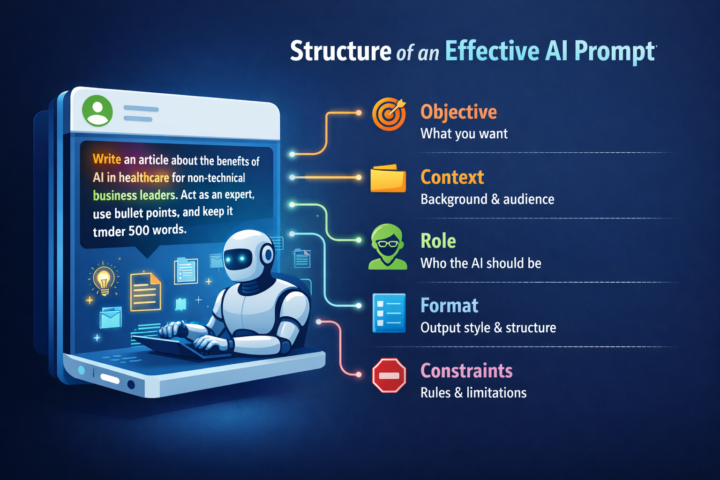
A good prompt isn’t long—it’s intentional. The most effective prompts usually include five key components.
1. Clear Objective
Start by stating exactly what you want.
Instead of:
“Tell me about AI.”
Try:
“Explain the business benefits of using AI for customer support.”
Be explicit about the outcome you’re looking for: explanation, summary, comparison, recommendation, draft, analysis, etc.
2. Context
Provide background information the AI wouldn’t otherwise know.
Context can include:
- Audience (executives, beginners, technical users)
- Industry or domain
- Use case or scenario
- Prior assumptions or constraints
Example:
“This explanation is for non-technical business leaders in the healthcare industry.”
The more relevant context you give, the less guessing the AI has to do.
3. Role or Perspective
Assigning a role helps shape tone, depth, and framing.
Examples:
- “Act as a technical architect…”
- “Respond as a marketing strategist…”
- “Explain this as a teacher would to a beginner…”
This guides how the response is structured and how complex the language should be.
4. Output Format
Tell the AI how you want the answer delivered.
You might specify:
- Bullet points vs. paragraphs
- Length (short summary, detailed explanation)
- Tables, steps, or examples
- Tone (professional, conversational, persuasive)
Example:
“Provide a concise, bullet-point list with real-world examples.”
This avoids rework and makes outputs immediately usable.
5. Constraints and Quality Checks
Set boundaries to refine the response.
Constraints might include:
- “Do not use technical jargon”
- “Limit to 500 words”
- “Avoid mentioning specific vendors”
- “Include pros and cons”
You can also ask the AI to validate its work:
“If assumptions are required, clearly state them.”
A Simple Prompt Structure You Can Reuse
Here’s a reusable framework that works across AI platforms:
Objective: What you want
Context: Background and audience
Role: Who the AI should act as
Format: How the output should look
Constraints: Rules or limits
Example Prompt
“Create a blog post explaining the importance of AI prompts.
The audience is business professionals with limited AI experience.
Act as a technology strategist and educator.
Use clear headings and practical examples.
Keep it under 1,000 words and avoid referencing specific AI tools.”
Prompting Is a Skill—Not a Trick
Effective prompting isn’t about secret phrases or magic keywords. It’s about:
- Clear thinking
- Structured communication
- Iteration and refinement
As AI becomes more embedded in everyday workflows, prompt literacy will be as important as writing an email or building a slide deck.
Those who learn how to ask better questions won’t just get better AI outputs—they’ll make better decisions, faster.
Final Thought
AI is a force multiplier, not a mind reader.
If you want better results from any AI system, don’t start by switching tools. Start by improving your prompts.
Because when you prompt with clarity, structure, and intent—AI delivers.